
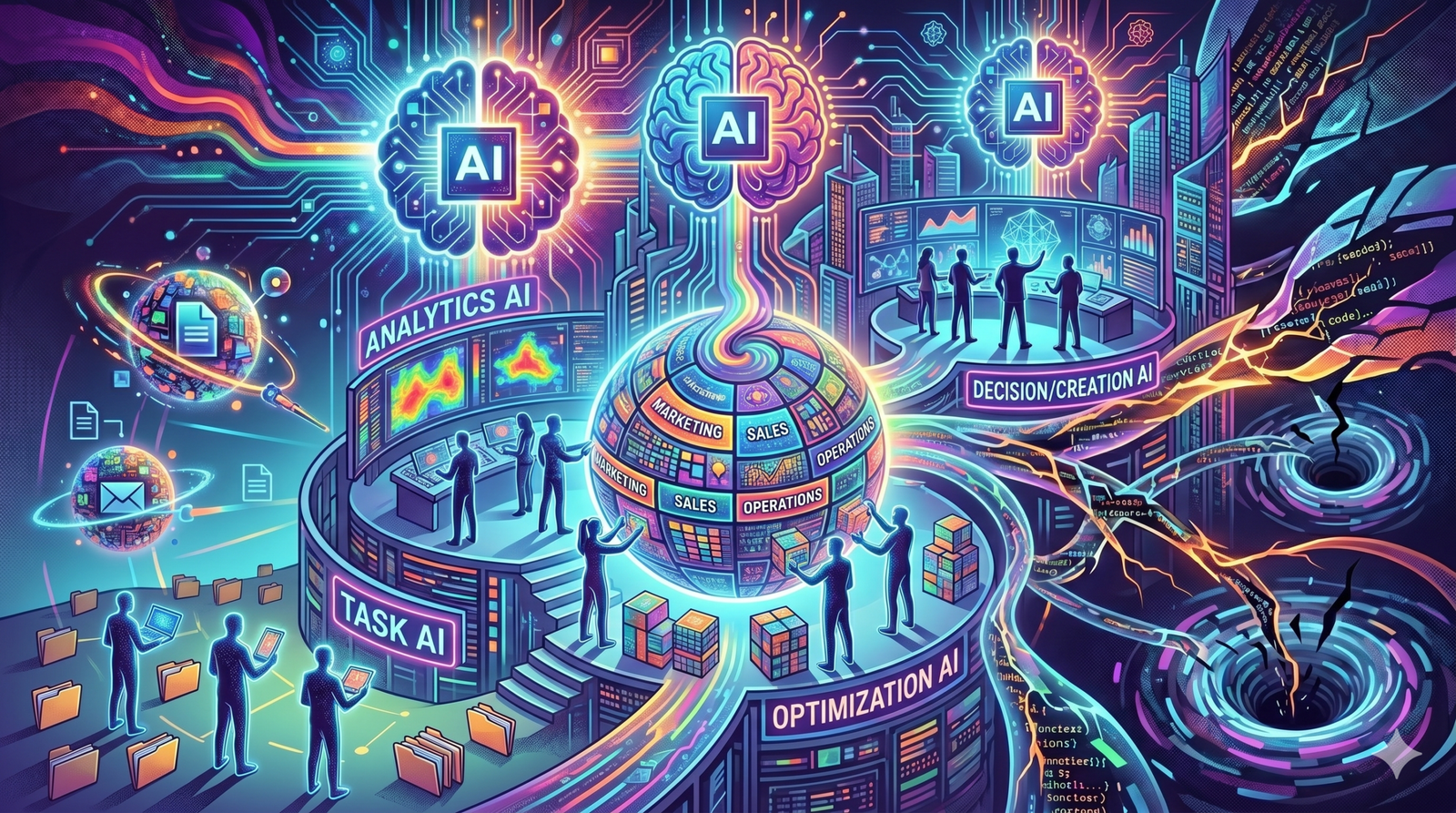
Everyone is talking about using AI in business. But “using AI” does not mean the same thing for everyone.
For one business owner, it may mean using ChatGPT to write a WhatsApp message. For another, it may mean connecting AI to internal documents. For someone else, it may mean allowing AI agents to follow up with customers, update CRM records, or even build internal software.
So before we ask, “Should SMEs use AI?”, a better question is:
At what level is the SME using AI — and who is still in control?
The higher we go, the more AI moves from being a helper we manually call to becoming a participant inside the business. The benefit increases, but so do the risks around data, cost, customer experience, compliance, and accountability.
Table 1: SME AI Usage Levels
| Level | SME AI Stage | Buzzword | What it means | SME example | Human role | Cost / token exposure | Risk / caution |
|---|---|---|---|---|---|---|---|
| 1 | Free AI use | ChatGPT, Gemini, Claude, DeepSeek | You manually ask AI and use the answer | Captions, messages, ideas, translation | You ask, read, decide | Free or limited free usage | Low, but don’t share sensitive data |
| 2 | Paid AI use | Plus / Pro / Advanced AI | More capable AI used manually | Emails, proposals, reports, Excel help, planning | You ask, read, decide | Fixed monthly subscription; usage limits may apply | Low to moderate |
| 3 | Multimodal AI | Multimodal | AI can read text, images, PDFs, screenshots, audio, etc. | Invoice reading, product photos, forms, catalogues | You still trigger AI manually | Subscription or usage limits; file-heavy work may cost more | Moderate; wrong interpretation risk |
| 4 | AI with your business data | RAG | AI searches or refers to your own documents/data before answering | Price lists, SOPs, FAQs, policies, catalogues | You control what data it can access | Token usage during search and answers; recurring cost possible | Data exposure and wrong-answer risk |
| 5 | AI inside business tools | AI-enabled CRM / ERP / Marketing / Sales tools | AI features built into tools you already use | Auto drafts, summaries, lead scoring, invoice reminders | You review AI suggestions inside the tool | Usually subscription-based; token cost hidden inside vendor pricing | Vendor-dependent; data risk; hidden pricing or lock-in risk |
| 6 | AI automation | Workflow automation | AI is connected to repeated workflows | Lead follow-up, reminders, report generation, stock alerts | You define rules and monitor | Token usage during operations; cost may grow with volume | Workflow errors, data risk, unplanned operating cost, tool dependency |
| 7 | AI agents | Agents / Agentic AI | AI can take steps on its own: read, decide, act, update, message | Agent follows up leads, updates CRM, prepares reports | Human supervises and sets boundaries | Token usage during operations; cost not yet stabilized | High; needs strong controls; data, cost, customer experience, compliance and legal risks |
At Levels 1 and 2, AI is mostly helping us think, write, summarize, or plan. At Levels 4 to 7, AI starts touching business data, workflows, customers, tools, and decisions. That is where SMEs need to become more careful.
A simple cost rule is this:
Building with AI may be a one-time cost. Running a business process through AI may become a permanent meter.
If AI is used only while designing or building something, the token cost may stop after development. But if AI is used every day inside operations, token usage becomes a recurring business cost. These costs have not fully stabilized yet.
Table 2: When SMEs Use AI to Build Software or Apps
There is another important category: SMEs using AI to build software, dashboards, apps, portals, or internal tools. This is where terms like AI-assisted coding, agentic coding, vibe coding, and AI-reviewed code become important.
| Level | SME AI Software Stage | Buzzword | What it means | SME example | Human role | Cost / token exposure | Risk / caution |
|---|---|---|---|---|---|---|---|
| 8 | AI-assisted coding | AI coding assistant / Copilot / Claude Code | AI helps write parts of the software, but a human designs and understands the system | Developer uses AI to build a quotation tool, dashboard, or report module faster | Human designs, reviews, tests, and owns the code | Token/subscription cost during development; usually no token cost during operations unless AI is embedded | Low to moderate if reviewed properly |
| 9 | Agentic coding | Agentic coding / coding agents | AI reads the codebase, edits files, runs commands, fixes errors, and iterates across steps | AI helps modify an internal order-tracking app or CRM workflow across multiple files | Human directs, supervises, reviews, and verifies | Higher token usage during development; usually no token cost during operations unless AI is embedded | Moderate to high; wrong changes can spread across the system |
| 10 | Vibe coding | Vibe coding / prompt-to-app / no-code AI app builders | Human describes what they want, AI builds something that seems to work, but internals are not deeply understood | Owner builds an app for orders, billing, stock, follow-up, or customer records by prompting AI | Human experiments and accepts what works on screen | Token/subscription cost during design/build; operations cost depends on platform and hosting | Very high if used for real business without technical review |
| 11 | AI-generated, human-reviewed systems | AI-generated code with white-box review | AI writes major parts of the system, but a capable human reviews architecture, code, security, testing, and failure cases | SME builds a custom MIS, customer portal, or operations tool with AI support and developer review | Human remains clearly accountable | Token cost during development; operations cost depends on whether AI is embedded in the app | Manageable if properly reviewed, tested, and maintained |
| 12 | AI-generated, AI-reviewed, human-rubber-stamped systems | AI reviewing AI | AI writes code, AI reviews it, AI explains why it is fine, and humans approve without deeply understanding | Business-critical app is built fast, but nobody can clearly explain or maintain it | Human appears accountable but may not be meaningfully in control | Token cost during development and review; operational cost may also continue if AI is embedded | Extremely high; creates hidden technical, business, data, legal, and continuity risks |
In software, the main risk is not whether AI helped write the code. The real risk is whether any capable human understands, reviews, tests, maintains, and owns what has been built.
AI can help build business software faster. But if nobody understands the system, the business may become dependent on something it cannot control.
The Core Question for SMEs
AI is useful. It can save time, reduce manual work, improve communication, support decision-making, and help build internal tools faster. But SMEs should not use AI blindly.
Before using AI deeply in business, every SME owner should ask:
- Am I using AI to improve my thinking, or am I surrendering my thinking to AI?
- Am I using AI to become more independent, or am I becoming dependent on tools, vendors, subscriptions, token costs, and lock-ins I do not fully understand?
- Who understands the system?
- Who checks the output?
- Who owns the decision if something goes wrong?
AI should help SMEs become smarter, faster, and more capable. It should not quietly take away thinking, independence, data control, or business ownership.
Use AI. But do not surrender your judgment, your data, or your business control.
About the Author
Bhagath Singh Karunakaran is an entrepreneur, systems thinker, and deep-tech practitioner with over two decades of experience across software, IoT, Industry 4.0, and AI-led business transformation. He is the founder of i45G, where he works with SMEs, institutions, and leaders on practical technology adoption, systems thinking, workforce readiness, and AI-enabled business transformation.
Through his writing and consulting, he focuses on helping business owners and decision-makers move beyond hype and adopt technology with clarity, ownership, and measurable value.